Stinging insects in Mississippi fall into two very different categories: aggressive predators that defend a colony (paper wasps, yellow jackets, hornets) and structural pests (carpenter bees). Honeybees are a third category. They're beneficial pollinators we work to relocate when possible, not treat as pests.

Honeybees (Apis mellifera) are pollinators and a working population already under significant pressure from parasites, habitat loss, and pesticide exposure. If a swarm or established colony sets up on your property, the right first call is a local beekeeper, not a pest control company. We work with central Mississippi beekeepers and the Mississippi Beekeepers Association swarm directory to connect you with someone who can relocate the colony.
Most beekeepers will collect a swarm at no charge (they get a free colony for their operation). Established colonies inside a wall void are more complex because the comb must be removed along with the bees to prevent rotting honey and secondary pest problems. A beekeeper or a beekeeper-paired contractor can still handle it. We treat honeybees only as a last resort when relocation isn't feasible and there's an immediate safety concern.
One related question we hear: are Africanized killer bees in Mississippi? Per MSU Extension and the Mississippi Department of Agriculture and Commerce, no. Africanized honeybees are not established in Mississippi. They're present in southern Texas and parts of the desert Southwest, but the line has not advanced into the state. The aggressive stinging-insect call you have is almost certainly yellow jackets or hornets, not bees.
Treatment timing matters. Paper wasps and yellow jackets are most active during the day and most predictable at dusk when foragers return to the nest. We treat the nest entry directly with a residual material that knocks down returning workers as the colony comes back in. For yellow jacket nests in wall voids or underground, treatment focuses on the entry tunnel rather than trying to reach the nest core.
A single nest is a one-pass job. Properties with chronic wasp pressure (open eaves, shaded outdoor structures, large mulch beds, attic vents without screen) benefit from a seasonal program that includes preventive treatment of common nesting sites in March and April before colonies establish. Treating before a colony exists is dramatically easier and safer than treating a peak-summer colony.
Plugging a nest entry before the colony is fully dead is the most common DIY mistake. Surviving workers will chew a new opening, often inside the structure. We hold off on sealing entries until activity has stopped for several days.
Yellow jacket and paper wasp colonies follow a strong seasonal arc. Each colony starts in spring with a single overwintered queen, builds slowly through early summer, and reaches peak population in August and September. By that point a mature yellow jacket colony can hold several thousand workers, the queen's egg production drops, and workers shift from brood-tending to active foraging for sugars and protein.
The behavioral change is sharp. Workers become much more defensive of the nest, more likely to investigate human food and drinks at outdoor gatherings, and more likely to sting unprovoked. Most "got stung in my yard with no nest in sight" calls in Mississippi are foragers from a ground nest 50 to 100 feet away. This is the most dangerous window of the year for anyone with a known sting allergy.
Per the American Academy of Allergy, Asthma and Immunology, stinging-insect venom anaphylaxis causes roughly 60 to 80 deaths per year in the United States. Sensitization rates are higher in the South due to year-round exposure. If you've had a severe sting reaction before, carry epinephrine and talk to an allergist about venom immunotherapy. Call us early in the season for preventive nesting-site treatment.
Carpenter bees bore into untreated wood to lay eggs, and the same wood gallery often gets reused and expanded year over year. A long-untreated gallery system can run 4 to 10 feet inside a fascia board or deck rail. The structural damage is real, even though the individual entry hole looks almost decorative (a perfect half-inch circle drilled straight into the wood).
Treatment is a two-step. We dust each existing entry hole with a labeled professional product. Carpenter bees passing through the hole carry it into the gallery. After several days, when the gallery activity has stopped, we seal each hole with wood filler or a wooden plug and the surface gets painted or stained.
The structural fix is paint or pressure-treated wood. Carpenter bees rarely bore into painted or pressure-treated surfaces. Bare cedar, pine, and cypress on decks, pergolas, fascia, and eaves are the most-affected surfaces in Mississippi residential construction. For chronic carpenter bee pressure on a property, surface coating is the durable fix; insecticide alone is a seasonal patch.
Sources: Mississippi State University Extension Service (Bug's Eye View paper wasp, southern yellowjackets, European hornet, Africanized honeybee publications); Mississippi Beekeepers Association (swarm directory at mshoneybee.org/bee-removal-list); American Academy of Allergy, Asthma and Immunology (2023 anaphylaxis practice parameters); USDA Africanized Honey Bee distribution data; Mississippi Department of Agriculture and Commerce.
Common Questions
Treatment timing matters. Yellow jackets are most predictable at dusk when foragers return to the nest. We treat the nest entry directly with a residual material that knocks down returning workers as the colony comes back in. For wall-void or underground nests, treatment focuses on the entry tunnel. Trying to plug an entry before the colony is fully dead is a mistake; surviving workers chew a new exit and the problem relocates.
Colony peak. Paper wasp and yellow jacket colonies start small in spring with one queen, then grow steadily through summer. By August and September, a yellow jacket colony can hold several thousand workers, the queen's egg production drops, and workers shift from brood-tending to foraging for sugars and protein. They become much more defensive of the nest and more likely to investigate human food and movement. The late-summer aggression cliff is real, and it's the most dangerous window of the year.
All hornets are wasps, but not all wasps are hornets. In Mississippi the practical distinction: bald-faced hornets (Dolichovespula maculata) build the football-shaped gray paper nest hanging from a tree limb or eave and have bright white face markings on a black body. Paper wasps (Polistes spp.) build the open umbrella-shaped nest under porch eaves with the cells visible from below. Yellow jackets (Vespula spp.) are short and stout, black-and-yellow striped, and nest in cavities or underground.
For a small paper wasp nest under an accessible eave, a hardware-store labeled wasp-and-hornet product applied at dusk can work (yellow jackets are most predictable at dusk when foragers return to the nest). For a yellow jacket nest in a wall void or underground, or a bald-faced hornet nest at any meaningful height, the answer is no. The defensive response is sufficient that protective equipment matters, and the access angle on concealed nests requires experience. The hospital cost of a bad outcome exceeds the price of professional treatment.
Two-step. First, dust each existing entry hole with a labeled professional product so the bees passing through carry it into the gallery. After several days, when the gallery is clear, seal each hole with wood filler or a wooden plug and paint or stain the surface. Painted or pressure-treated wood resists new entry; bare cedar, pine, and cypress on decks and pergolas remain the most-affected surface in Mississippi.
No. Honeybees (Apis mellifera) are pollinators, not pests. They are hairy, golden-brown, and noticeably more docile than wasps. Mississippi honeybee populations are already under significant pressure from habitat loss, parasites, and pesticide exposure. If a swarm or established colony sets up on your property, the right first call is a local beekeeper. We help connect you with members of the Mississippi Beekeepers Association for relocation rather than treating honeybees as a pest call.
Call us first or call the Mississippi Beekeepers Association directly. Most beekeepers will collect a swarm at no charge because they get a free colony for their operation. Established colonies inside a wall void are more complex (the comb needs to be removed along with the bees to prevent rotting honey and secondary pest problems), but a beekeeper or a beekeeper-paired contractor can still handle it. Killing honeybees should be the last resort, not the first call.
Paper wasp queens emerge from overwintering sites in March and April and begin building nests under eaves, porch ceilings, and grill covers. Yellow jacket queens emerge in April and May to start ground or cavity nests. Bald-faced hornets follow a similar timing. Spring preventive treatment of common nesting sites (open eaves, exterior corners, attic vents) before colonies establish is dramatically more effective than reactive treatment in August.
No. Per Mississippi State University Extension and the Mississippi Department of Agriculture and Commerce, Africanized honeybees are not established in Mississippi. They are present in southern Texas, southern California, and parts of the desert Southwest, but the line has not advanced into Mississippi. The aggressive stinging-insect call you have is almost certainly yellow jackets or hornets, not bees.
Yes, take it seriously. Anaphylaxis from stinging-insect venom causes roughly 60 to 80 deaths per year in the United States per AAAAI data. Sensitization rates are higher in the South due to year-round exposure. If you have a history of severe sting reaction, carry epinephrine, talk to an allergist about venom immunotherapy, and call us early in the season for preventive nesting-site treatment before colonies establish.
Almost never. Mud daubers (Sceliphron caementarium and related species) are slim solitary wasps that build the tube-shaped mud nests on walls and overhangs. They hunt spiders, including black widows, and are considered beneficial. We generally leave them alone unless the nest location is genuinely problematic (over a doorway, inside an open garage, on outdoor furniture). The mud nests themselves are easy to scrape off with a putty knife after the larvae have emerged.
Why Trust Advantage Pest Services
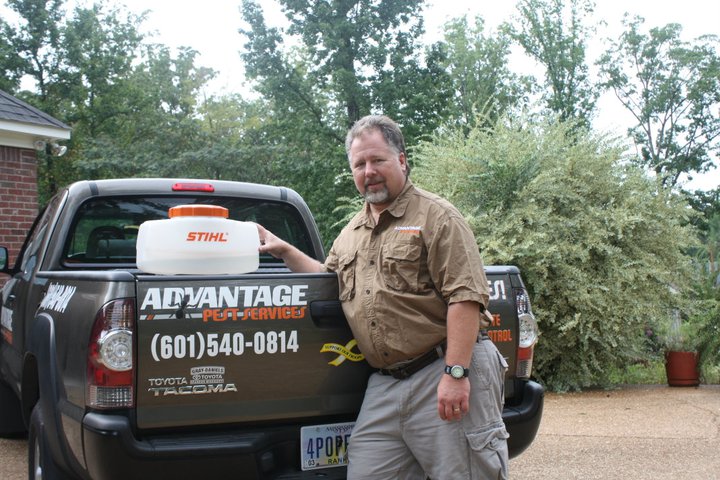
David is a Rankin County native. He has been in the pest control business since the 80s, working with national pest companies before founding Advantage Pest Services in Madison MS in April 2011. The reason he started his own company was simple: he wanted to bring a personal touch back to the work, and he wanted to be accountable to every property he services.
Every claim on this page traces back to a named primary source. The references we cite, document, and work from:
Service Areas
Rankin County seat, southeast of Madison
Madison County, Reservoir corridor
Hinds County, state capital
Rankin County, east of Jackson
Hinds County, west of Jackson
Hinds County, south of Jackson
Rankin County, south of Brandon
Related Field Guides