Byram is a Hinds County city on the eastern bank of the Pearl River, twenty-five miles south of our Madison home base and ten miles south of Jackson. The pest pressure here is what you would expect from a humid-subtropical city sitting against the Pearl River bottomlands, with the added Formosan termite presence and the I-55 corridor rodent factors that define southern Hinds County. We have run a Byram route since 2011.
Byram's residential corridor sits in USDA Hardiness Zone 8a, which is to say it sees humid summers in the low nineties, mild winters that do not freeze the soil deep enough to interrupt subterranean termite activity, and the year-round insect pressure that defines southern Hinds County. Inside city limits, your home is most likely between fifteen and forty years old, set on a pine-shaded or hardwood lot, and pressured by the same six species that define every Hinds County property: cockroaches, mosquitoes, spiders, ants, wasps, and termites. The added variable in Byram, and the one that shapes our entire route calendar, is the Pearl River bottomland on the eastern edge of the city.
Advantage Pest Services has worked Byram since 2011. We are based in Madison, twenty-five miles north by way of I-55 South. Our Byram route is regular, not on-demand. Most calls are scheduled inside a week. If your address is in ZIP code 39272 or the 39170 overlap on the Terry side, we serve you. If you live further out into rural southern Hinds County and you are unsure, call 601-540-0814 and we will confirm.
The city itself is eighteen and a half square miles, with the eastern boundary running along the Pearl River and the western and southern edges tied to the Gary Road, Siwell Road, and Byram-Terry Road corridors. The 2020 census put the population at 12,666, with a slight projected decline toward 12,467 by the middle of this decade and a median household income around $70,000. The civic footprint is small, but the ecological footprint is large: the floodplain on the river side adds a layer of pest pressure that interior Hinds County neighborhoods do not see, and the I-55 corridor on the west side adds another. Both factors shape how we sequence our route through the city.
We treat the full residential pest pressure of southern Hinds County. Byram's ecological position, on the western bank of the Pearl River with the eastern boundary running along the floodplain, shapes which species you actually see and when. Termites and Formosan subterranean colonies are the structural concern. Mosquitoes peak in July and August alongside the West Nile vector window, and the bottomland habitat extends that peak into early October. Fire ants build through spring and fall, and paper wasps colonize the eaves of pine-shaded homes from April through October. Rodent pressure in the Gary Road and I-55 corridors runs year-round, with seasonal spikes as temperatures drop in November.
Each of the six species below has a dedicated treatment page with the full anatomy, the regional pressure profile, and the treatment approach. Click any to read more.
A note on the seasonal calendar specific to Byram. The mild winters mean we rarely close out the route for any species. Subterranean termite swarmer flights begin in March and run through early June, with Formosan flights typically following a few weeks behind the native species. Mosquito populations start building on the bottomland edge in late April, reach peak density in late July, and stay elevated into October. Fire ant mound construction is bimodal, with strong activity in April and May and again in September and October. Carpenter ant satellite colonies become visible inside structures from May through August. Rodent pressure spikes in November as overnight temperatures drop and outdoor harborage becomes less attractive than the warm interior of a building. We adjust the cadence and the targeting on every property to match this calendar rather than applying a single template.
Field Guide · Byram MS Pest Pressure
Six species we identify, evaluate, and resolve year-round across every neighborhood in Byram city limits. Click any specimen to read its dedicated page.

Periplaneta americana
Resident in warm, humid environments: kitchens, basements, drains.

Aedes albopictus
Daytime biter; carrier of West Nile and EEE in the Southeast.

Loxosceles reclusa
Hides in storage. Bite is medically significant; identification matters.

Solenopsis invicta
Aggressive mound-builder. Damages lawns, equipment, and outdoor life.

Polistes spp.
Builds umbrella-shaped nests under eaves. Defensive of the colony.

Coptotermes formosanus
The Southeast's most destructive termite. Call us if you suspect activity.
We take selected commercial accounts in Byram on a case-by-case basis, focused on owner-occupied offices and small businesses. David qualifies each commercial inquiry by phone first to make sure we're the right fit. Our general commercial scope lives on the commercial pest control page.
Every Byram property starts with an evaluation. We walk the inside and the outside, including crawl spaces and accessible attic areas, and we identify any pests present along with the entry points and conditions feeding them. We document what we find and write a treatment plan with pricing. There is no obligation to sign for service. If we find nothing that warrants treatment, we tell you so. The point of the evaluation is the evaluation, not the upsell.
For ongoing customers, our standard residential plan is quarterly. Four visits a year, each addressing interior, perimeter, and exterior harborage in the cadence the property actually needs. Termite inspection, mosquito service (which we recommend more aggressively on the bottomland-adjacent streets of Riverbend and eastern South Byram), and high-pressure additions (a fresh fire ant mound, a paper wasp nest under the eave, a rodent run along the property edge) can be added without re-quoting the plan.
Inside the inspection itself, the Byram-specific points of attention are reasonably consistent property to property. On the river side of the city, we pay particular attention to crawl-space moisture, condensate drainage off HVAC equipment, and any standing-water reservoirs (uncovered rain barrels, neglected planter trays, sagging gutters) that contribute directly to the local mosquito population. On the I-55 side, we focus on structural exclusion: gaps under garage doors, weep-hole protection on brick veneer, utility-line penetrations through the foundation, and any compromised door sweeps that give rodents a path inside. Across the entire city, the Formosan termite question informs how we assess wood-to-soil contact, deck post bases, the integrity of any subfloor that has seen prior moisture damage, and the condition of any wood-framed outbuilding within a few feet of the home. None of this is exotic, but the order and emphasis shift by neighborhood, and a Byram-experienced eye finds things a generic interior inspection misses.
Pest control in Mississippi is regulated by the Mississippi Department of Agriculture and Commerce, Bureau of Plant Industry under Mississippi Code Title 69, Chapters 19 and 23. Our license categories cover General Pest and Rodent (GRC) and Mosquito and Biting Fly (MBF). Licenses are renewed on a three-year cycle, and every technician carries a current MDAC-issued identification card. You can ask to see it on any visit.
The practical accountability is local. Advantage Pest Services has operated in Madison since 2011. David McNeece, the owner, has been in the pest control business since the early 1980s and lives in the same central Mississippi community he services. There is no regional call center between you and the work. If something isn't right, you talk to David.
One additional regulatory note specific to fire ant treatment in Hinds County. Mississippi falls inside the federal imported fire ant quarantine administered by USDA APHIS under 7 CFR Part 301 Subpart P, which restricts the movement of certain regulated articles (nursery stock, soil, hay, sod, used soil movers) out of quarantined counties. This rarely affects a homeowner directly, but it does shape how landscape and construction contractors operate in the area. When we treat a property for fire ants, we work to the same MSU Extension two-step protocol the state has used since the quarantine was established, with broadcast bait applications timed to the spring and fall foraging windows and individual mound treatment as needed in between.
Why Trust Advantage Pest Services
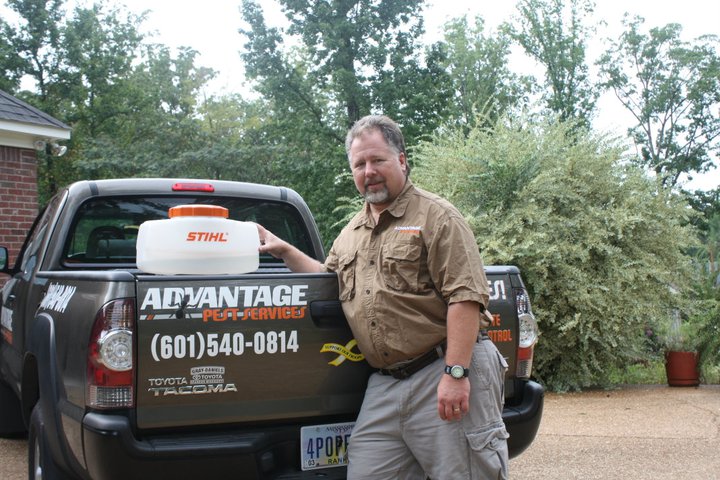
David is a Rankin County native. He has been in the pest control business since the 80s, working with national pest companies before founding Advantage Pest Services in Madison MS in April 2011. The reason he started his own company was simple: he wanted to bring a personal touch back to the work, and he wanted to be accountable to every property he services.
Byram's residential map is a mix of named subdivisions and named-road corridors. McLaurin Heights, on the western side of town near McLaurin Heritage Park, is one of the established residential cores, with a mix of homes built across the eighties and nineties. Byram Heights occupies the central interior, where the pine and hardwood canopy supports the carpenter ant and paper wasp pressure that comes with mature landscaping. South Byram extends toward the Byram-Terry Road corridor, where the city begins to meet the rural-suburban interface that defines southern Hinds County. Riverbend, true to the name, sits closest to the Pearl River and carries the highest mosquito pressure on the route. Cedar Ridge and Pine Lake fill out the central residential picture, each with its own service rhythm. The Gary Road, Siwell Road, and Byram-Terry Road corridors carry a mix of residential and commercial addresses we treat under the same local accountability.
Byram itself takes its name from an early settler family. The community was originally incorporated in 1870, later lost its incorporation, and was re-incorporated on June 16, 2009 after a multi-year annexation dispute with the city of Jackson that ended at the Mississippi Supreme Court. The most recognized landmark inside the city is the Byram Swinging Bridge, the 1905 pedestrian suspension bridge over the Pearl River pictured at the top of this page. It is an early twentieth-century piece of river infrastructure, still standing, and the engineering anchor of local civic identity. The bridge, together with the Pearl River crossing, McLaurin Heritage Park, Byram Municipal Park, and the Beverly J. Brown Library behind city hall, give Byram a small set of civic anchors that the residential streets radiate out from.
For the purposes of pest control routing, the micro-geography matters. Riverbend and the easternmost edge of South Byram, both within a short walk of the Pearl River floodplain, get a different treatment cadence than McLaurin Heights or Cedar Ridge in the interior. The bottomland drainage extends a long way past the visible bank in wet years, and any property with a low spot in the back yard, a slow-draining ditch, or a creek tributary running through it is effectively part of the same mosquito-amplification system. We tend to recommend a more aggressive mosquito component on those streets, often paired with the standard quarterly general-pest service. Pine Lake and Byram Heights, set back from the river, see more typical interior-Hinds pressure with carpenter ants and paper wasps as the recurring callouts. The Gary Road and Siwell Road corridors, with their mix of residential and commercial frontage, sit between the two profiles and see whichever pressure happens to be in season.
The Byram-Terry Road corridor deserves its own short note. That road carries the city south into Terry, and the residential addresses along it sit on larger lots than the Byram core, with more wooded frontage and a less continuous municipal infrastructure. The pest profile shifts accordingly: fire ant pressure is noticeably stronger on those lots, carpenter ant activity is more common, and rodent pressure tilts toward white-footed mouse and roof rat. We treat these properties under the same MDAC license categories, but the inspection emphasis runs longer on the exterior and the structural exclusion side, and the cadence often suits a tri-annual rather than a strict quarterly plan.
Most Byram families fall inside the Hinds County School District, anchored by Gary Road Elementary, Gary Road Intermediate, Byram Middle School, and Terry High School in nearby Terry. The District covers the southern Hinds County footprint, and the schools themselves carry pest protocols separate from the residential treatment we provide. The clustering of the Gary Road campuses along the central corridor of the city is one of the reasons we keep mosquito service in mind for residential addresses within a half mile of those schools: campus-adjacent properties tend to see the same standing-water and turf factors that drive the broader corridor population, and parents with young children often want a more proactive treatment cadence during the school year.
The ecology around Byram is what drives the pest calendar. USDA Zone 8a humid subtropical means winter low averages near 37°F (mild enough that subterranean termite foraging continues year-round on warmer ground) and summer high averages near 92°F with humidity well into the seventies. The city receives roughly fifty-seven inches of annual rainfall, which is enough to keep the Pearl River bottomlands on the eastern edge of town actively wet through most of the year. The floodplain forest east of Riverbend, with its alluvial soils, slow-moving backwater, and seasonal sheet flow, is one of the strongest mosquito breeding amplifiers in southern Hinds County, comparable in its own way to the reservoir-margin pressure further north.
Byram soil is a mix of alluvial bottomland on the river side and Ultisols on the ridge sections, loamy and sandy and generally well drained outside the floodplain. The pine and hardwood mix in the residential interior supports the carpenter ant and paper wasp pressure homeowners actually see, while the river edge supports the mosquito and biting-fly pressure that defines summer outdoor living in this part of the state. The I-55 corridor, running directly through the western edge of the city, adds the rodent and transient-pest factor any interstate-adjacent municipality contends with.
Two ecological notes worth pulling out for anyone trying to understand why Byram pest pressure is what it is. The first is rainfall. Roughly fifty-seven inches a year is enough to keep the soil profile damp through most of the calendar, and the bottomland to the east effectively never dries out completely. Subterranean termite foraging benefits from this: the species needs persistent soil moisture to maintain mud tubes, and Byram supplies that almost without interruption. The second is canopy density. Loblolly pine, slash pine, and mixed hardwood lots are the rule rather than the exception inside the city, and the shaded, leaf-littered ground beneath a mature canopy supports paper wasp construction in the eaves, carpenter ant foraging into soft fascia and trim, and the year-round spider population that thrives anywhere arthropods are abundant. None of this is unusual for central Mississippi, but in Byram it is concentrated by the small city footprint and the river boundary into a particularly consistent profile.
Every claim on this page traces back to a named primary source. Pest control regulation is a real legal framework, and a Byram property owner should be able to verify any technical assertion we make. The references we cite, document, and work from across Byram and the Hinds County service area:
Byram Service Area
From our Madison home base, our technicians work Byram on a regular route. Most Byram properties can be evaluated within a few days of your first call. If you are unsure whether your address is in our service area, ring 601-540-0814 and we will tell you.
Get driving directionsCities in Our Corridor
Drill down by pest
Field Survey · 2026
Pick up the phone. We'll talk through what you're seeing, ask a few questions about the home and the property, and figure out together whether an on-site evaluation is the right next step. No forms. No high-pressure sales.