Most ant problems are not one ant problem. Fire ants in the lawn, carpenter ants in a porch column, and sugar ants on the kitchen counter are three separate jobs. We identify the species, locate the colony, and choose a treatment that solves the actual problem instead of just spraying the trail you can see.

Most household ant species, especially odorous house ants and Argentine ants, respond to surface sprays by budding. The colony fractures, and each fragment can produce a new queen. You end up with two or three smaller trails instead of one. The right professional approach is built around the biology of budding species so the colony is eliminated from the inside rather than scattered.
Argentine ants take this to an extreme. They form supercolonies that connect across multiple properties through shared scent trails. Single-property treatment of an Argentine ant population is genuinely difficult and rarely produces permanent elimination. Expectations need to match the biology.
The red imported fire ant has been established in Mississippi since the 1950s. The entire state was placed under the Federal Imported Fire Ant Quarantine on May 6, 1958 under 7 CFR Part 301 Subpart P. The quarantine restricts movement of nursery stock, sod, baled hay, and soil-moving equipment across state lines without certification. About 125 Mississippi nurseries hold compliance agreements with USDA APHIS and the Mississippi Department of Agriculture and Commerce.
For homeowners, the practical implication is that fire ant mounds will keep showing up no matter how aggressively any one property is treated, because the surrounding landscape stays populated. Seasonal programs manage the pressure; nothing "eliminates" them permanently from a single yard.
MSU Extension recommends the two-step approach: a yard-level bait pass two to four times a year, paired with direct treatment for individual visible mounds as they appear. Baits work slowly (3 to 8 weeks) but reach the queen via worker-fed larvae and queen contact. Mound treatments work fast on the mounds you can see but do not stop new colonies. Used together, the two methods cover both visible and incipient mounds.
Carpenter ants do not eat wood. They excavate it to build galleries for the colony. The damage looks similar to termite damage at first glance but reads very differently on close inspection: carpenter ant galleries are smooth and clean with fine sawdust frass pushed out of small slit openings; termite damage is packed with mud, frass, and termite feces, and runs along the wood grain.
Almost every carpenter ant infestation has a moisture story underneath it. Damp wood is dramatically easier to excavate than dry sound wood, and carpenter ants are good at finding the softest target. Common Madison MS scenarios: a window sill with slow leak from failed glazing, a deck post sitting in damp ground, fascia board under a leaking gutter, a roof flashing that leaks during heavy rain, a bath trap with a slow drain leak weeping into the subfloor.
For carpenter ant work, we start with a moisture inspection. We want to know which water source is feeding the colony before we treat. Treatment is targeted to the gallery and a perimeter band, paired with whatever moisture remediation the structure needs. Treatment without addressing the underlying water source is temporary.
First, a property walk to identify the species, follow the trails back to entry points, and locate the colony itself if it's accessible. The treatment approach depends on what we find, and each species gets the right plan for its biology. We walk you through the specifics during the on-site evaluation.
We provide a free written evaluation before any work. The evaluation identifies the species, locates the colony or trail system, and recommends the treatment plan in writing. You decide whether to proceed. No high-pressure tactics.
Sources: Mississippi State University Extension Service (Publication P2429 and Fire Ant Programs); USDA APHIS Imported Fire Ant Program (7 CFR Part 301 Subpart P); Mississippi Department of Agriculture and Commerce, Bureau of Plant Industry; National Pest Management Association; NIH/PMC published anaphylaxis prevalence data.
Common Questions
Mississippi State University Extension recommends the two-step approach. A yard-level bait pass two to four times a year (Easter, Independence Day, and Labor Day are easy reminders) is paired with direct treatment for individual visible mounds as they appear. Baits work slowly but reach the queen; mound treatments work fast on the mounds you can see. Together they keep a yard nearly fire-ant-free.
It depends on the approach. A professional yard-level treatment is generally labeled for several months of activity, with most programs running on a 1 to 2 visit per year cadence. Mound treatments work fast on the mounds you can see but do not stop new mounds. Mississippi is under federal quarantine, so the surrounding landscape stays populated. A seasonal program is realistic; permanent elimination from a single yard is not.
For most people, painful but not medically serious. The sting produces a sterile pustule within a few hours. Risk rises sharply with multiple stings, with very young children, with elderly adults, and with anyone allergic. Anaphylaxis prevalence in fire-ant-colonized states is about 0.085% of the general population per NIH-published data. Sensitization rates exceed 90% among residents. If you have a history of severe sting reaction, keep epinephrine accessible and consider venom immunotherapy through an allergist.
Three quick checks. Body: carpenter ants have a pinched waist, termites have a straight body. Antennae: ants have elbowed antennae, termites have bead-like (straight) antennae. Wings (if winged): ants have unequal-length wings, termites have wings all the same length. Damage check: carpenter ant galleries are smooth and clean with sawdust frass pushed outside; termite damage runs along the wood grain with mud packed into the channels.
Because the spray is making it worse. Odorous house ants (the 'sugar ant' most people mean) live in multi-queen colonies that reproduce by budding. A repellent spray scatters the colony into satellite nests, so the trail you killed becomes three smaller trails the next week. The fix is professional treatment built for budding species, which workers carry back to all queens instead of scattering the colony.
Fire ants are active year-round but visible mounds peak after the spring (March to May) and fall nuptial flights when new queens land and start colonies. Foraging peaks at soil temperatures of 70 to 95 degrees F. Best treatment windows are early spring (before the first flight) and late summer to early fall when foraging is high and the colony is recruiting new workers.
When applied to label, professional ant treatment is targeted with limited non-target impact. We coordinate timing around your pet schedule. If you have medical issues or are pregnant, we always recommend you consult your professional health care provider.
Yes, for individual mounds. Hardware-store labeled mound treatments work on the mounds you can see. For a whole yard with recurring mounds, the math usually favors a single professional yard-level pass plus mound-treatment service over buying a spreader and the labor of weekend reapplications. The other DIY trap is using a fertilizer spreader for bait: the setting is wrong and you'll put out 10 times the label rate.
Boiling water works on small isolated mounds but kills the surrounding grass and rarely reaches the queen on a large mound. Baking soda plus vinegar is folklore. Grits do not 'explode' ant stomachs (workers regurgitate food to larvae; only larvae eat solid food, and grits do not swell uncontrollably). Save your time and use a labeled bait.
Regular quarterly pest control covers indoor ants (odorous house ants, pavement ants), spiders, roaches, and the foundation perimeter. Fire ant work is a separate yard-level service, usually 1 to 2 visits per year on top of the regular plan. Some homeowners bundle them; others use regular pest control alone and call us out only when fire ant pressure becomes uncomfortable.
Yes. The entire state of Mississippi is under the Federal Imported Fire Ant Quarantine, established May 6, 1958 under 7 CFR Part 301 Subpart P. Practical effect for homeowners is none direct. For landscapers, sod farms, and nurseries: any nursery stock, sod, baled hay, or used soil-moving equipment moved out of state must be certified free of imported fire ants. About 125 Mississippi nurseries hold compliance agreements with MDAC and USDA APHIS.
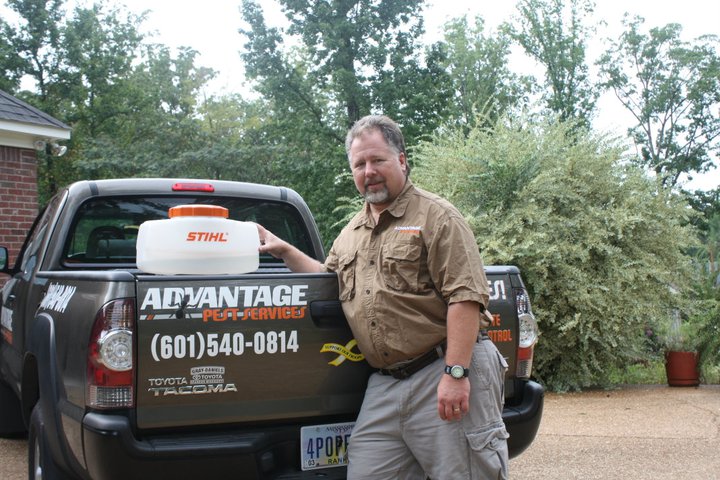
Why Trust Advantage Pest Services
David is a Rankin County native. He has been in the pest control business since the 80s, working with national pest companies before founding Advantage Pest Services in Madison MS in April 2011. The reason he started his own company was simple: he wanted to bring a personal touch back to the work, and he wanted to be accountable to every property he services.
Every claim on this page traces back to a named primary source. The references we cite, document, and work from:
Service Areas
Rankin County seat, southeast of Madison
Madison County, Reservoir corridor
Hinds County, state capital
Rankin County, east of Jackson
Hinds County, west of Jackson
Hinds County, south of Jackson
Rankin County, south of Brandon
Related Field Guides